What is an End-Suction Centrifugal Pump?
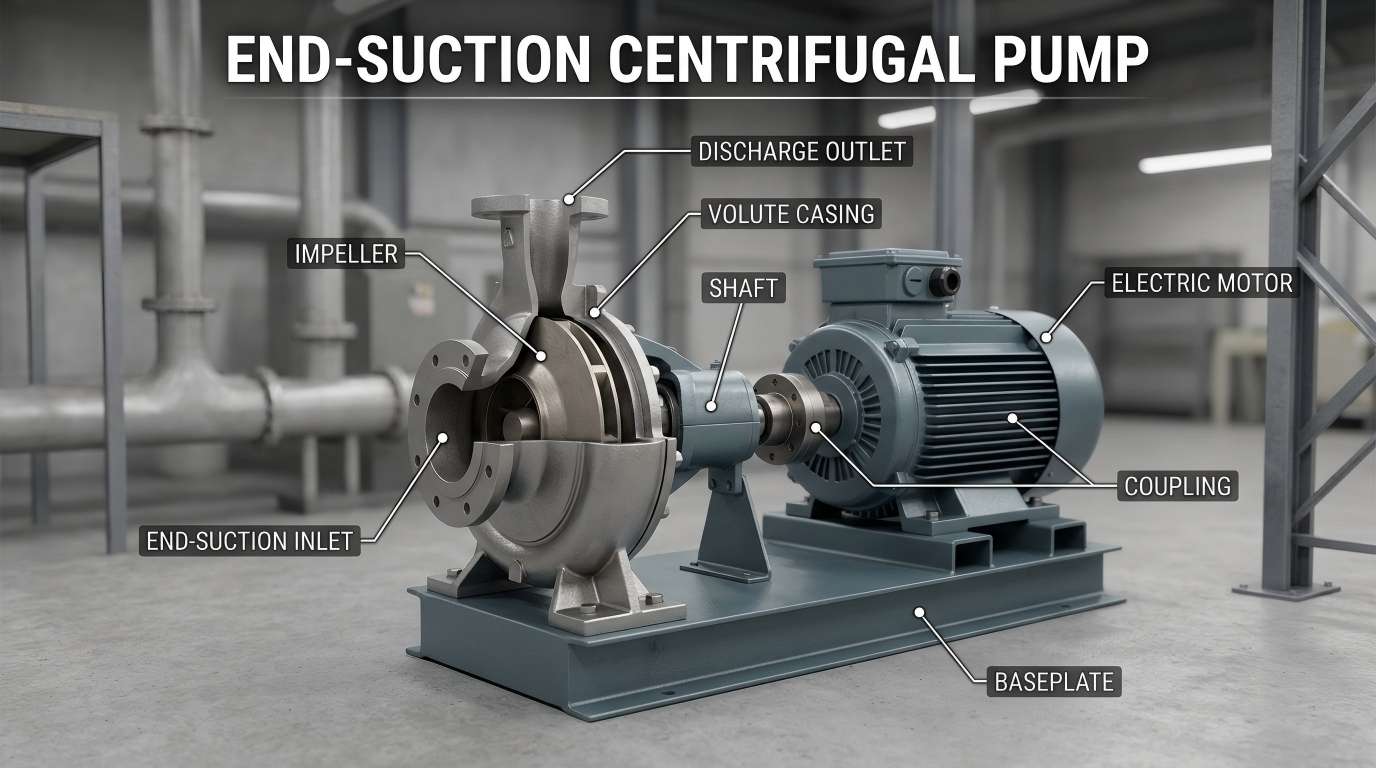
In industrial fluid transfer, building HVAC systems, and municipal water supply systems, you will always find a familiar piece of equipment—the end-suction centrifugal pump.
What is an End-Suction Centrifugal Pump?
An end-suction centrifugal pump, as its name suggests, is a single-stage, single-suction centrifugal pump where liquid enters axially from the side of the pump casing and is discharged radially from the top of the pump casing after being accelerated by the impeller.
It is also known as a horizontal end-suction pump in the industry. Its most prominent feature is its back pull-out design. This design allows maintenance personnel to extract the rotating components (including the impeller, shaft, seals, etc.) directly for maintenance without removing the inlet and outlet pipelines. For engineers, this means minimal downtime and low maintenance costs.
Working Principle of an End-Suction Centrifugal Pump
The working principle of an end-suction centrifugal pump is straightforward, following the basic logic of most centrifugal pumps, with a focus on its unique end-suction design. Here is a clear step-by-step explanation:
- Fluid Suction: The pump draws in fluid through the suction port at the end of the pump casing (opposite the motor), and the fluid flows directly into the eye of the rotating impeller.
- Centrifugal Force Generation: Driven by the motor, the impeller rotates, and centrifugal force pushes the fluid from the center of the impeller to its outer edge, increasing the fluid’s velocity and pressure.
- Fluid Discharge: The high-velocity fluid enters the pump casing (also known as the volute), which has a gradually expanding shape to slow down the fluid and convert kinetic energy into static pressure energy. The fluid is then discharged through the discharge port on the side of the pump casing to the target location (such as pipelines, storage tanks, etc.).
- Continuous Operation: As long as the motor runs continuously, the above process repeats continuously, achieving stable and continuous fluid transfer. The end-suction design ensures smooth fluid entry, reducing turbulence and improving operating efficiency.
Key Components of an End-Suction Centrifugal Pump
To help you better understand the working principle of an end-suction centrifugal pump, its main components are broken down and explained in plain language below:
- Impeller: A rotating component similar to a "fan" used to generate centrifugal force. It is usually made of metal (stainless steel, cast iron) or plastic, depending on the type of fluid being transferred.
- Pump Casing (Volute): The outer casing enclosing the impeller, shaped to collect fluid discharged from the impeller, slow down the fluid, and increase pressure before discharge.
- Suction Port: An opening at the end of the pump casing through which fluid enters the pump body. It is usually equipped with a flange (with a raised edge) for easy connection to pipelines.
- Discharge Port: An opening on the side of the pump casing through which fluid exits the pump body. It is also equipped with a flange to guide fluid into the piping system.
- Shaft: A rod-shaped component connecting the impeller and the motor, responsible for transmitting power from the motor to the impeller and driving the impeller to rotate.
- Seals: Prevent fluid leakage from the shaft gap (between the pump body and the motor). Common types include mechanical seals and packing seals.
Wide Range of Applications
- HVAC: End-suction pumps are the core power source for chilled water circulation and cooling water systems in large buildings.
- Industrial Water Supply and Pressurization: Used for clean water transfer, pressurization systems, and boiler feed water in factories.
- Fire Protection Systems: Special fire-fighting end-suction pumps provide stable high-pressure water flow in emergencies.
- Agricultural Irrigation: Widely used in farmland irrigation and drainage due to its wide flow range.
Summary
The end-suction centrifugal pump is a reliable, cost-effective solution for most fluid transfer needs. Its simple structure, easy maintenance, and wide application make it popular among engineers, facility managers, and property owners.
For more in-depth insights into fluid control, follow Omron Tech Pumps. Let’s explore the infinite possibilities of the fluid world together!